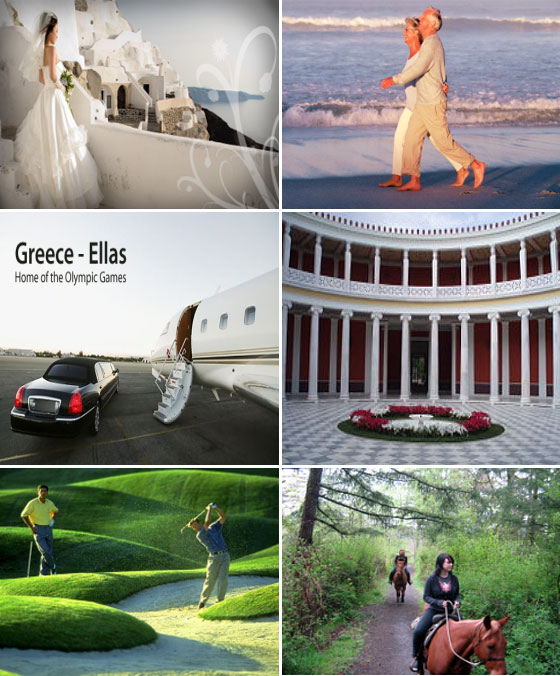
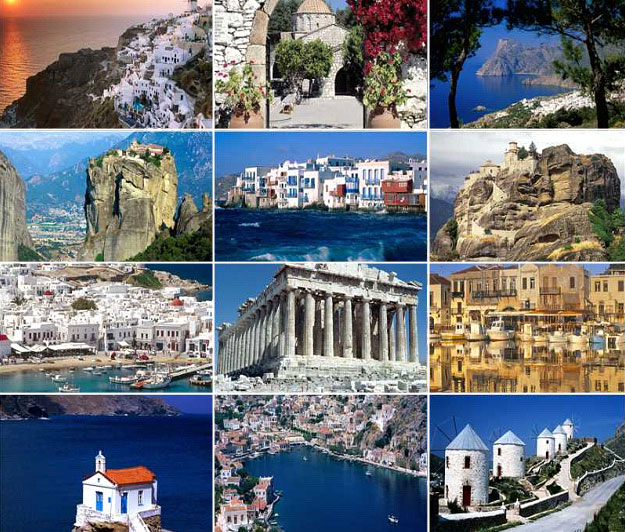
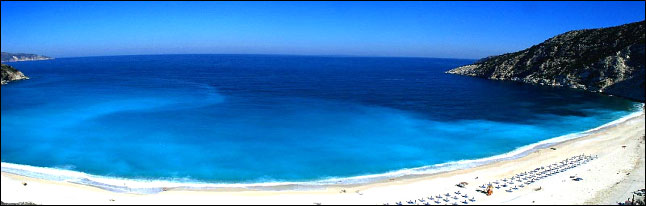
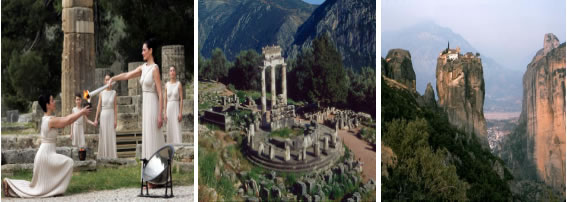
VISIT GREECE THE COUNTRY OF ALL SEASONS
ONE LAND MILLION PICTURES
Visit Greece info site:
www.visitgreece.gr/
Greece location
Greece is located in south-eastern Europe. It lies at the meeting point of three continents – Europe, Asia and Africa. Greece borders to the North on Bulgaria and the Yugoslavia, to the Northwest on Albania, to the Northeast on Turkey, to the West it is washed by the Ionian Sea, to the South by the Mediterranean Sea and to the East by the Aegean Sea.
The total area of Greece is 131,957 km2 and consists of three main geographic areas:
- a peninsula mainland (that extends from the region of Central Greece on the South to the region of Thrace on the North) being the biggest geographic feature of the country
- the Peloponnese peninsula that is separated from the mainland by the canal of the Corinth Isthmus
- and around 6.000 islands and islets, scattered in the Aegean and Ionian Sea, most of them grouped in clusters, that constitute the unique Greek archipelago. Crete, Rhodes, Corfu, the Dodecanese and the Cyclades are some of the famous and popular islands and island clusters in Greece
Eighty percent of the country consists of mountains or hills, making Greece one of the most mountainous countries of Europe; furthermore, it has 16.000 kilometres of coastline of which 7500 are found around the thousands islands of the Greek archipelago, a truly unparalleled phenomenon on the European continent.
Athens
In above photos you see the monument of the unknown soldier, the Acropolis, the Panathenaic Stadium where the fisrt Olympic Games in 1896 where held, the Temple of Zeus and the National Library. All above mentioned with many more Athens highlights are visited through half day Athens sightseeing tour (full description of tour on
page 30 of our brochure).
Short presentation about Athens
Athens is the capital and largest city of Greece, dominates the Attica periphery, as one of the world's oldest cities, its recorded history spans around 3,400 years.
A cosmopolitan metropolis, Athens is central to economic, financial, industrial, political and cultural life in Greece and it is rated as an alpha- world city.
Classical Athens was a powerful city-state. A centre for the arts, learning and philosophy, home of Plato's Academy and Aristotle's Lyceum, it is widely referred to as the cradle of Western civilization and the birthplace of democracy, largely due to the impact of its cultural and political achievements during the 5th and 4th centuries BC on the rest of the then known European continent.
The heritage of the classical era is still evident in the city, represented by a number of ancient monuments and works of art, the most famous of all being the Parthenon, widely considered a key landmark of early Western civilization. The city also retains a vast variety of Roman and Byzantine monuments, as well as a smaller number of remaining Ottoman monuments projecting the city's long history across the centuries. Athens was the host city of the first modern-day Olympic Games in 1896, and 108 years later it welcomed home the 2004 Summer Olympics.
We suggest to stay in Athens at least 2 nights in order to have time to visit the most important monuments and do your shopping in Plaka area which is the old city of Athens full of shops with traditional products.
During Winter period we suggest to stay in Athens for more days and according to the days that you have available to do a tour in the mainland for 2, 3 or 4 days visiting Delphi, Meteora, Olympia.
Greece is amongst the few countries in the world which offers a marvelous temperate climate. Here “Winter” does not mean sub-zero temperatures or snowfalls that last for hours or even days on end.
It does rain, of course, now and then but the rain is just enough to freshen-up the leaves and water the trees.Immediately after the rains the sun will shine even brighter than before. Summer is usually followed by a long golden Autumn and a few cold spells of Winter particurly in the Northern part of Greece.
The Greek Gods bestowed January with “Halcyon days”, meaning the Zeus has gifted January with calm seas and summery warmth to the land, so that “Halcyons” mythical bords, could come down from the skies and lay their eggs. With the departure of the large tourist crowds of the Summer period, the Winter visitor to Athens and the Greek islands, is offered the added attraction of heavily reduced “Winter Season” prices plus, of course, a better service.
During Summer period we suggest to stay in Athens 2 nights and then visit the Greek Beautiful islands. You will need minimum 2 nights. On each island in order to have enough time.
If your time does not permit to stay in the islands then another option is to do our One Day Cruise which starts from the port of Athens (Piraeus) visits 3 Saronic islands Aegina-Poros-Hydra you have included lunch on board and return to Athens the same day late in the afternoon for overnight at your hotel in Athens.
If time permits to stay in islands then if you prefer to visit the famous Cycladic islands there is ferry and air connection. There is air connection the whole year, ferry connection between islands at the moment is available from April to October, from November to March clients can do either the 1-day cruise which operates daily the whole year or if they want to travel by ferry only then visit 1 island as at the moment island hoping is available by ferry from April to October.
To go by ferry you need to overnight at least 1 night in Athens and the next day to go to the port to embark to your ferry. If you prefer to travel by air then you can also connect upon arrival at the Athens airport with a flight to your preferred island.
Greek most famous Cycladic islands
Mykonos
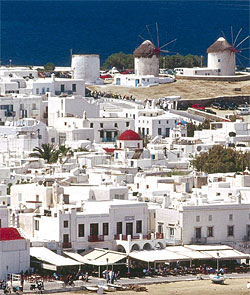
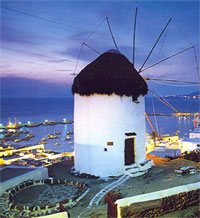
One of the most renowned tourist destinations in the world! Mykonos is the most famous Greek island in the world and the favorite destination of celebrities from around the globe. It is also one of the most beautiful Cycladic islands with many bare hills, amazing sandy beaches, exceptionally well-preserved Cycladic architecture, white chapels and uniquely beautiful landscapes.
During the last decades many villas and hotels have been constructed without, however, spoiling the character and the architectural features of the island.
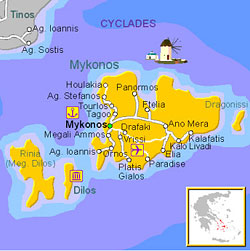
Mykonos is located approximately in the center of the complex of the Cyclades between Tinos and Naxos. It is the nearest island to Dilos.
The island extends over a surface of 87 km2, its coastline is 82 km long and it has 9,350 inhabitants. The local airport connects the island with Athens, Thessaloniki and other Greek towns.
Duration:
From Athens to Mykonos by flight: about less than 1 hour.
From Athens (Piraeus port) to Mykonos: about 5.5 hours by regular ferry.
From Athens (Piraeus port) to Mykonos: about 4 hours by high speed ferry.
Santorini
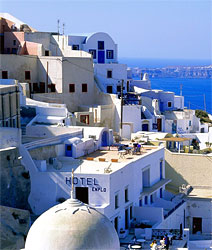
It is one of the most famous islands of the Cyclades as well as one of the most renowned Greek islands around the globe and the number one choice for honeymooners due to the fantastic sunset. Santorini presents a unique geological phenomenon, as today it is what has been left from the initial one (Stroggyli), which was submerged into the sea after the eruption of its volcano during the 16th century B.C. This was one of the most violent eruptions in the history of the Earth: the three quarters of the island were submerged, forming the Caldera (crater), while one of the most serious consequences caused by the eruption was the destruction of the Minoan palaces in Crete. The island extends over a surface of 73 km2, its coastline is 69.5 km long and it has 13,670 inhabitants.
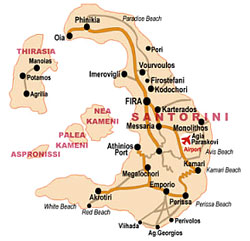 Santorini is the southernmost island of the Cyclades. Actually it is an island complex which comprises of Thira, Thirasia, Aspronisi, Palia and Nea Kameni. The tourist development of the last decades was frenetic, but the island still remains attractive, full of secrets and unknown beauties and continues to have one of the most famous sunsets of the planet. It is also famous for its local production of wine as the vines have been cultivated since the ancient times.
Duration:
From Athens to Santorini by flight: about less than 1 hour.
From Athens (Piraeus port) to Santorini: about 8 hours by regular ferry.
From Athens (Piraeus port) to Santorini: about 5 hours by high speed ferry.
Paros
Paros is located at the heart of the island complex of Cyclades and is one of the most popular holiday destinations due to its exceptional natural beauty, vast sandy beaches, crystal-blue waters and impressive landscapes.
The island extends over a surface of 195 km2, its coastline is 120 km long and it has 12,800 inhabitants. It is a cosmopolitan resort with a well-developed tourist infrastructure.
Duration:
From Athens to Paros by flight: about less than 1 hour.
From Athens (Piraeus port) to Paros: about 4.5 hours by regular ferry.
From Athens (Piraeus port) to Paros: about 3 hours by high speed ferry.
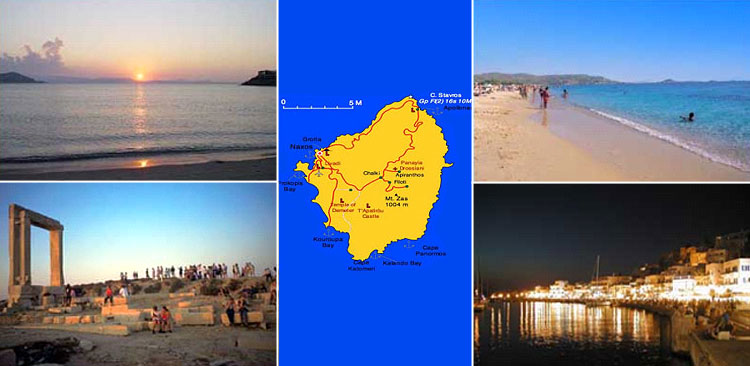
Naxos
It is the biggest and the most fertile island of the Cyclades.
The particular character of its landscape lies on the very high mountains (the Mount Zas, 1,004 m, is the highest of the Cyclades) and the uniquely special mountain villages. The island extends over a surface of 428 km2, its coastline is 148 km long and it has 18,000 inhabitants.
During the ancient years, Naxos was the island where Dionysus was worshipped. According to mythology, it was on this island that he met the Minoan Ariadni, who had been abandoned there by Theseus.
From ancient times until today, the island has an exceptional production of citrus fruits, famous wine and tasteful cheese.
Duration:
From Athens (Piraeus port) to Naxos: about 5.5 hours by regular ferry
From Athens (Piraeus port) to Naxos: about 3.5 hours by high speed ferry
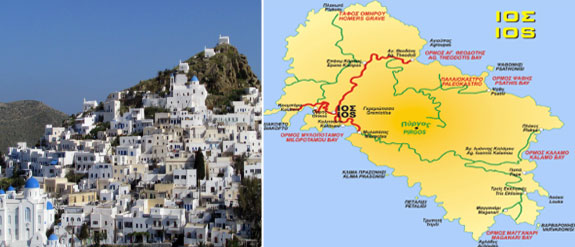
Ios
Ios or Nios, as the locals call it, is one of the most beautiful islands in the Cyclades complex.
Due to its vivid night life it has an international fame especially among young people.
It is located among Santorini, Paros and Naxos and is full of bays and vast sandy beaches. Its coastline is 81.5 km long, 32 km of which are sandy beaches.
According to ancient mythology, Ios was the home place of Homer’s mother and the place where he was buried. Archeologists have discovered a first Cycladic settlement in Skarko and ruins of historic times. It extends over 108 km2 and has 1.830 inhabitants.
Duration:
From Athens (Piraeus port) to Ios: about 8 hours by regular ferry.
From Athens (Piraeus port) to Ios: about 4.5 hours by high speed ferry.
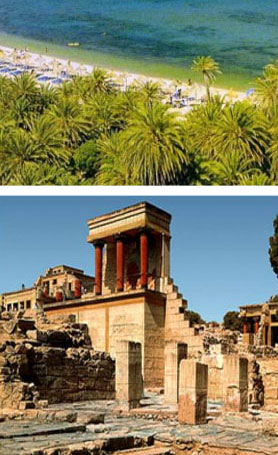
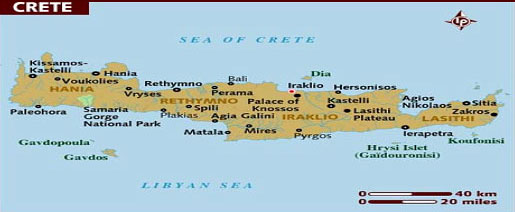
Crete
Heraklion is the capital of Crete Greece, its larger urban centre and the economical centre of the island. It offers all the possible touristy facilities and activities and an exciting nightlife. Many archaeological sites can be visited in Heraklion as well as beautiful churches. Concerning culture and entertainment, Heraklion is particularly rich, especially in summer when cultural events are organized all around the city.
Chania is the largest and most important town of western Crete Greece and the capital of the western part. Even if it is a quite big city with 60,000 inhabitants, Chania has kept its authenticity and its local colours. The traditional old quarters, the colourful houses, the narrow alleys and the flowered gardens are embellishing the city and make it an ideal place to enjoy well-organised and exciting holidays.
Lassithi is a municipality which is part of the island of Crete Greece.
It has many archaeological sites to visit as well as many beautiful caves and gorges. Some dovecotes and wonderful churches can also be seen in the area.
According to mythology, this area is the birthplace of Zeus. The town of Lassithi is a lovely town with a wide range of touristy facilities and activities to offer to the visitor.
Rethymno is one of the main cities of Crete Greece and one of the loveliest too. It is divided into the Old Town and the New Town which are both delightful. The old part of Rethymno is particularly beautiful, full of old buildings and stone-paved narrow alleys. A huge Venetian fortress is overlooking the city, adding a touch of mystery. An endless sandy beach and the impressive gorge of Kourtaliotiko are worth-visiting. Moreover, the recently-founded University of Rethymno has given a new vibe to the city.
Duration:
From Athens to Heraklio (Crete) by flight: about less than 1 hour.
From Athens to Chania (Crete) by flight: about less than 1 hour.
From Athens (Piraeus port) to Heraklio, Crete: about 9-10 hours by regular ferry (usually overnight ferry)
From Athens (Piraeus port) to Heraklio, Crete: about 6-7 hours by high speed morning ferry.
From Athens (Piraeus port) to Chania, Crete: about 9-10 hours by regular ferry (usually overnight ferry)
Rhodes
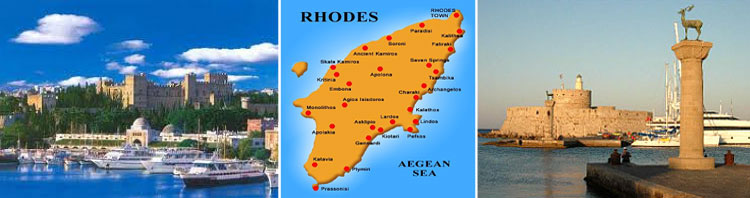
It is the fourth largest Greek island – following Crete, Evoia, and Lesvos, and with its endless coastlines, its mountains full of pine-trees, mountainous villages, archaeological sites and its medieval town of unique beauty, Rhodes attracts over one million tourists every year.
It is the largest island of Dodecanese complex, extends over a surface of 1,398 km2, its coastline is 220 km and counts 120,000 inhabitants. It was firstly inhabited during prehistoric age and flourished during Mycenae Period. It became especially prosperous during 4th century B.C, when the famous Colossus of Rhodes was built by Lindios Haris, apprentice of Lysippos. After the disastrous earthquake in 155 A.C, the island met many conquerors (Persians, Arabs, Saracens as well as Seltzouk Turks). In 1309 the Knights of St. John came in the island, renovating the castle with a unique fortification technique for the European standards of that time.
Duration:
From Athens to Rhodes by flight: about less than 1 hour.
From Athens (Piraeus port) to Rhodes: about 13-18 hours by regular ferry.
Zakynthos
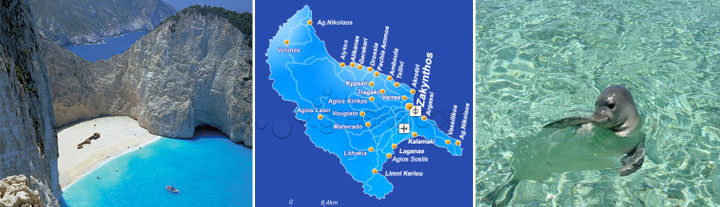
Zakynthos or Zante is a lush-green island with fertile plains and a pleasant climate.
It extends over 406 km2 and its coastline length reaches 123 km.
The alternation of the landscape resulting in a wide variety of beaches is very interesting. So, if you prefer peaceful sandy beaches with clear blue waters located in calm coves, you should go to the southeastern part of the island. If, on the other hand, you like impressive rocks and are interested in the seabed, you should prefer the western part of the island.
The Venetians, who governed Zante between 1484 and 1797, called the island “Fioro di Levante" (the flower of the East), because more than 7,000 types of flowers can be found on the island. Zakynthos (known around the world as "Zante") is the third biggest island of the Ionian Sea after Corfu and Kefalonia.
Duration:
From Athens to Zakynthos by flight: about less than 1 hour.
From Killini port (about 290 km from Athens) to Zakynthos: about 1 hour by regular ferry.
Kefallonia
|
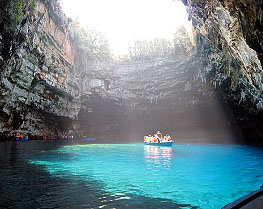
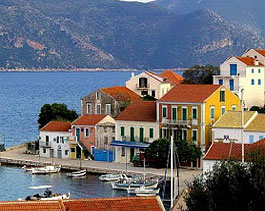
The magnificent sights, amazing beaches, rich cultural heritage, great monuments, mountains, castles, remote monasteries and cheerful, hospitable people are the treasures making Kefalonia one of the most attractive destinations.
It is the biggest island of the Ionian Sea, at the outlet of Patraikos Bay, between Zante and Lefkada. It stretches over an area of 904 km with a coastline length of 250 km.
The island has a splendid natural beauty and a diversified geological structure with innumerable small bays and rich vegetation; the mountain Aenos (National Park since 1962 supporting rich flora and fauna) looks impressive from far away.
The movie ‘’Captain Corelli’s Mandolin’’ shot in the natural scenery of the Resistance movement.
Duration:
From Athens to Kefallonia by flight:
about less than 1 hour
From Killini port (about 290 km from Athens) to Kefallonia:
about 2 hours by regular ferry
From Patra port (about 250 km from Athens) to Kefallonia:
about 3 hours by regular ferry |
Corfu
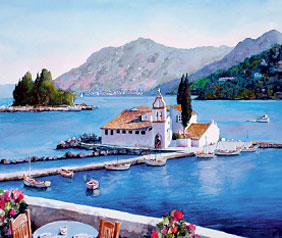
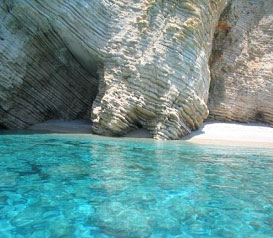
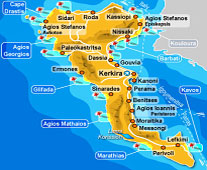
The cosmopolitan island of Corfu is probably the most well known island of the Ionian complex and one of the most popular in the whole Mediterranean. It is a pole of attraction for hundreds of thousands visitors every year as well as source of inspiration for all kinds of art, carrying a huge cultural heritage and disposing special splendor which combined with its natural beauty, marvelous climate, beaches and interesting sights, makes the island one of the top destinations for Greek and foreign travelers. Its area covers a surface of 591 km2 and its coasts stretch 217 km.
Corfu (Kerkira) was named after a woman. According to mythology, Poseidon fell in love with the daughter of Aesopos, Korkira, and brought her to this island naming it after her. The offspring of this love was a little boy, named Faiakas. He was to establish later the Kingdom of Faiakes, which according to Homer was the last stop of Ulysses before he returned to Ithaca.
The international name of Corfu was given to the island due to the two citadels (perched on two different tops) which can be found in the town of Corfu. Another ancient name that we can meet is Drepanon (scythe), which was attributed to the island because of its shape.
Corfu defines the Hellenic sea borders with Italy and Albania. This strategic position is responsible for the many conquests the island has undergone, influencing its culture, mores and customs. The Venetians, the French and the English passed on to the island many strong cultural elements resulting in the integration of the western culture to the Greek identity. Corfu joined Greece in 1864. The island has made a significant contribution to education, literature, arts and politics.
It is the biggest preserved medieval town in Greece and one of the most beautiful in the whole Mediterranean.
Duration:
From Athens to Corfu by flight: about less than 1 hour.
From Patra port (about 250 km from Athens) to Corfu: about 7 hours by overnight ferry.
From Igoumenitsa port (about 500 km from Athens) to Corfu: about 2 hours by regular ferry.
Thessaloniki
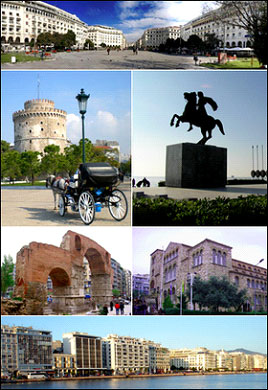
Thessaloniki is the second-largest city in Greece and the capital of the region of Central Macedonia. Thessaloniki is Greece's second major economic, industrial, commercial and political centre, and a major transportation hub for the rest of southeastern Europe, its commercial port is also of great importance for Greece and the southeastern European hinterland. The city is renowned for its festivals, events and vibrant cultural life in general and is considered to be Greece's cultural capital. Events such as the Thessaloniki International Trade Fair and the Thessaloniki International Film Festival are held annually, while the city also hosts the largest bi-annual meeting of the Greek diaspora. In 2014 Thessaloniki will be the European Youth Capital. Thessaloniki is home to numerous notable Byzantine monuments, including the Paleochristian and Byzantine monuments of Thessaloniki, a UNESCO World Heritage Site, as well as several Roman, Ottoman and Sephardic Jewish structures. With a history of over 2,300 years, it is one of Europe's oldest cities. The city's main university, Aristotle University, is the largest in Greece and in the Balkans.
The city is a major railway hub for the Balkans, with direct connections to Sofia, Skopje, Belgrade, Moscow, Vienna, Budapest, Bucharest and Istanbul, alongside Athens and other destinations in Greece. It is the most important railway hub of Greece and has the biggest marshalling yard in the country. Air traffic to and from the city is served by Macedonia International Airport for international and domestic flights.
Duration:
From Athens to Τhessaloniki by flight : About 45 minutes
From Athens to Τhessaloniki by car rental: About 6 hours
There are also organized tours departing from Athens visiting Thessaloniki (see page 30)
Chalkidiki
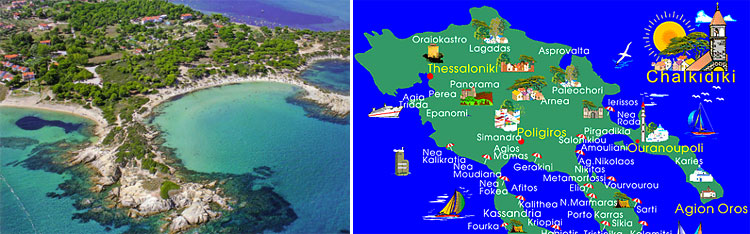
Chalkidiki is a peninsula in northern Greece, and one of the regional units of Greece. It is part of the region of Central Macedonia. The autonomous Mount Athos region is part of the peninsula, but not of the regional unit. The capital of Chalkidiki is the main town of Polygyros, located in the centre of the peninsula.
Chalkidiki consists of a large peninsula in the northwestern Aegean Sea, resembling a hand with three "fingers" (though in Greek these peninsulas are often referred to as "legs") – Pallene (now Kassandra), Sithonia, and Agion Oros (the ancient Acte), which contains Mount Athos and its monasteries. Chalkidiki borders on the regional unit of Thessaloniki to the north. There are several Summer resorts on the beaches of all three fingers where other minor towns and villages are located, such as at Yerakini (Gerakina Beach), Neos Marmaras (Porto Carras), Ouranoupolis, Nikiti, Psakoudia, Kallithea (Pallene/Pallini, Athos), Sani Resort and more.
Duration:
From Thessaloniki to Chalkidiki by car rental : About 2-3 hours
From Athens to Chalkidiki by car rental: About 7-8 hours
Olympia
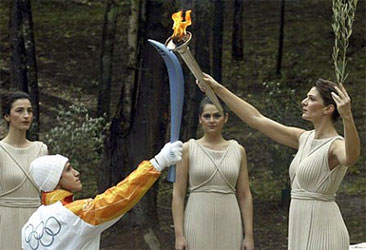
Olympia, a sanctuary of ancient Greece in Elia, is known for having been the site of the Olympic Games in classical times, comparable in importance to the Pythian Games held in Delphi. Both games were held every Olympiad (i.e. every four years), the Olympic Games dating back possibly further than 776 BC. In 394 AD, (after exactly 1169 years) emperor Theodosius I abolished them as they were then considered reminiscent of paganism. The first Olympic Games were in Olympia in honor of Zeus.
Duration:
From Athens to Olympia by car rental: About 4.5 hours
There are also organized tours departing from Athens visiting Olympia. Please visit our brochure page 30 for details.
Epidaurus
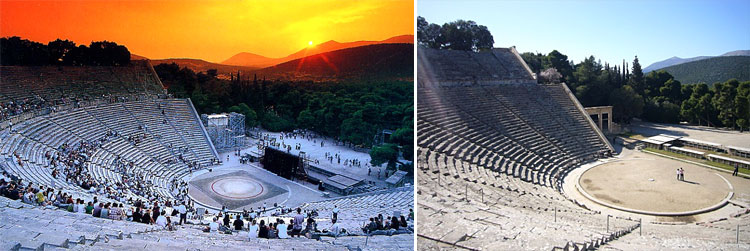
Epidaurus is a small city part of the peripheral unit of Argolis. The archaeological site was the birthplace of Apollo's son Asclepius, the healer, Epidaurus was known for its sanctuary situated about five miles (8 km) from the town, as well as its theater, which is once again in use today. The theatre is marveled for its exceptional acoustics, which permit almost perfect intelligibility of unamplified spoken word from the proscenium to all 15,000 spectators, regardless of their seating. Famously, tour guides have their groups scattered in the stands and show them how they can easily hear the sound of a match struck at center-stage.
Duration: From Athens to Epidaurus by car rental: About 2.5 hours
There are also organized tours departing from Athens visiting Epidaurus. Please visit our brochure page 30 for details.
Nafplio
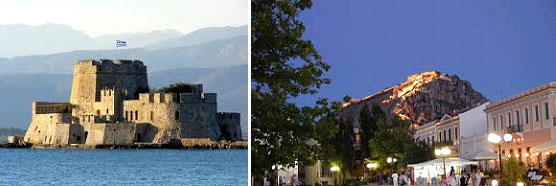
One of the most beautiful towns in the area of Argolis (in eastern Peloponnese) as well as one of the most romantic cities all over Greece, Nafplio was the first capital of the newly born Greek state between 1823 and 1834. Ancient walls, medieval castles, monuments and statues, Ottoman fountains and Venetian or neoclassical buildings mesmerize the visitor with their unique architecture and beauty. Choose among luxurious hotels overlooking Bourtzi, fabulous mansions, traditional guesthouses with respect to the local architecture.
Duration:
From Athens to Epidaurus by car rental: About 1.5 hours
There are also organized tours departing from Athens visiting Nafplion. Please visit our brochure page 30 for details.
Delphi
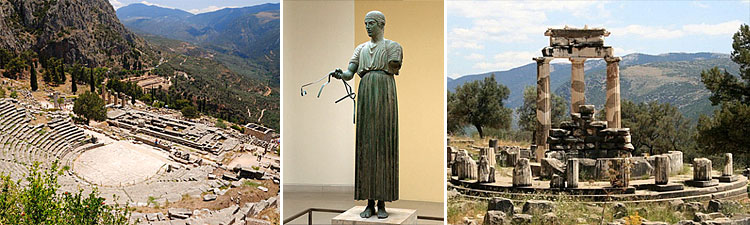
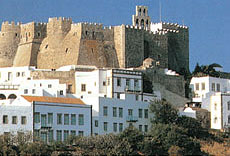
At the foot of Mount Parnassos, within the angle formed by the twin rocks of the Phaedriades, lies the Pan-Hellenic sanctuary of Delphi, which had the most famous oracle of ancient Greece. Delphi was regarded as the centre of the world. Delphi is both an archaeological site and a modern town in Greece on the south-western spur of Mount Parnassus in the valley of Phocis. The archaeological site of Delphi includes two sanctuaries, dedicated to Apollo and Athena, and other buildings, mostly intended for sports.
Duration: From Athens to Delphi by car rental: about 3 hours
There are also organized tours departing from Athens visiting Delphi. Please visit our brochure page 30 for details.
Meteora
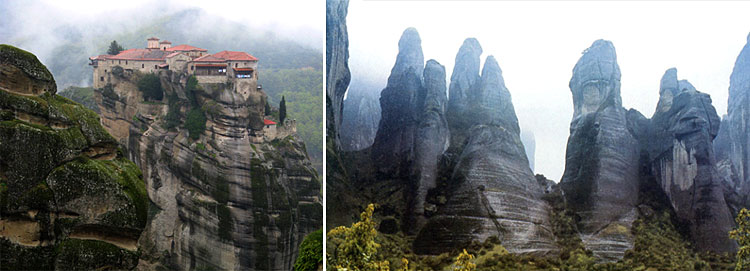
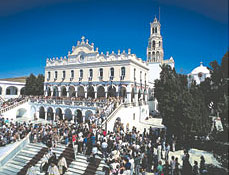
Meteora is one of the largest and most important complexes of Eastern Orthodox monasteries in Greece. The six monasteries are built on natural sandstone rock pillars, at the northwestern edge of the Plain of Thessaly near the Pineios river and Pindus Mountains, in central Greece. The nearest town is Kalambaka.
Meteora, apart from an important monument of Orthodoxy, constitutes also a unique in beauty geological phenomenon. The single rocks reach in height until 400 metres. It' worths to be mentioned that they are recognized as preservable and protected monument of humanity from the UNESCO and other international organizations.
Duration: From Athens to Meteora by car rental: About 4.5 hours
There are also organized tours departing from Athens visiting Meteora. Please visit our brochure page 30 for details.
Piraeus
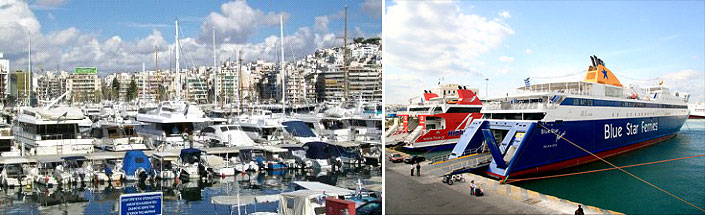
Piraeus is a city in the region of Attica, Greece. Piraeus is located within the Athens Urban Area, 12 km southwest from its city center (municipality of Athens), and lies along the east coast of the Saronic Gulf. The port of Piraeus is the chief port in Greece, the largest passenger port in Europe servicing about 20 million passengers annually. From Piraeus port you can travel to the most famous islands, Cyclades, Crete, Rhodes etc.
Patmos
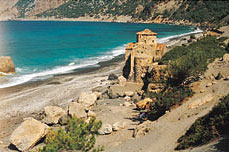
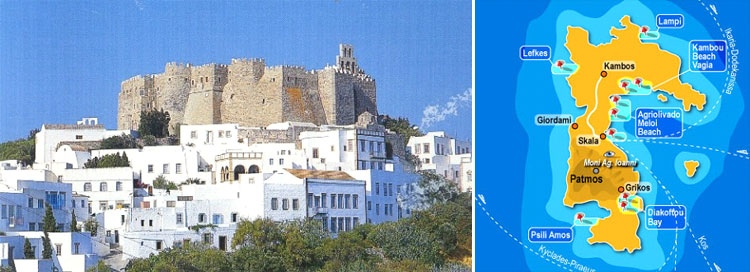 Worldwide known as a sacred island for it is the place where Saint John wrote the Book of Revelation, Patmos is an ideal destination for nature lovers thanks to its lace-like coastline, sheer cliffs and volcanic soil. Patmos is designated as “Holy Island” by the Greek Parliament in 1981 as well as a World Heritage Site by UNESCO in 1999. The Holy Monastery of the Apocalypse was built as a castle in 1088 by the monk Christodoulos Latrinós. Cultural and religious centre since its first day of use, it took another five centuries for it to spread its activities all around the island – and not just the town of Hóra (Chora), where it is situated. Around this Monastery revolve Holy Week and Easter celebrations every year.
Buildings of different ages form the Monastery, comprising 10 chapels and 99 cells as well as a Library of 890 handwritten codes and 13,000 documents about the history of the site. The largest settlement, as well as capital and port of the island, is Skála where you will find accommodation and fresh-fish tavernas among buildings used by the Italians during the Italian Rule of the Dodecanese (1912-1943).
At 5km from Skála have a rest stop at the village of Grikos, and enjoy the freshness of a drink by the sea,or even a swim at the beach by the same name.
You can travel to Patmos by sea from Piraeus, Samos (flying dolphins), Rhodes, Kos, Kalymnos and Leros as well as Syros in the Cyclades. The above mentioned Dodecanese islands have airports from where visitors can reach Patmos through regular ferry connections, especially during the summer season.
Kos
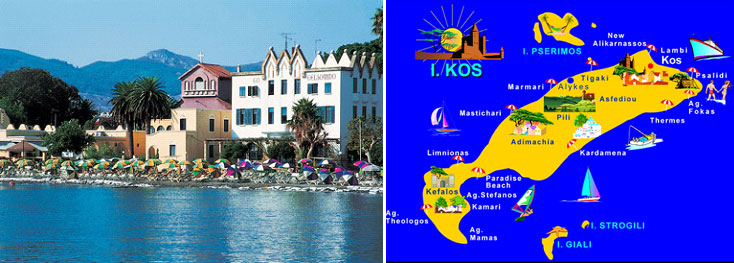
The endless coasts with the turquoise waters, the vegetation, the affluent water springs, the ancient and medieval monuments, as well as the impressive Italian buildings feature Kos island which is the third largest island of Dodecanese complex, located just 4 miles away from the Turkish coasts. Kos is the birthplace of Hippocrates «the father of medicine» (460-377 B.C). The island extends over a surface of 290 km2; its coastline is 112 km and counts 31,000 inhabitants. It can be reached by ferry from Piraeus Port or by airplane from the Athens International Airport, «Eleftherios Venizelos».
Skiathos
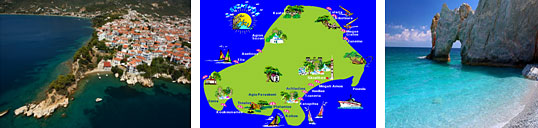
Skiathos, alongside the islands of Skopelos, Alonisos and other smaller islands, belongs to the group of islands called Northern Sporades which can be found in the Aegean Sea. It was the first island where tourism started developing and has since been one of the cornerstones in Greek tourism. Every year, thousands of tourists choose Skiathos for their summer vacation, while more than a few others visit the island during the winter time, where they can find an almost poetic kind of beauty, ideal for some relaxation.
Skiathos covers an area of around 49 square kms with a shoreline of about 44 kms and has a population of around 6,500. Skiathos is covered in green, since pine trees cover most of the island. These forests are filled with paths perfect for romantic walks and hiking tours that can lead you to monasteries and other monuments. The island has a total of 64 beaches and if we had to specifically pick out some of them, we would choose Koukounaries, Lalaria, Banana, Kastro and the little island of Tsougria.
Duration:
From Athens to Skiathos by flight: about 50 minutes.
From Agios Konstantinos port (about 160 km from Athens) to Skiathos: about 2 hours by regular ferry.
Syros
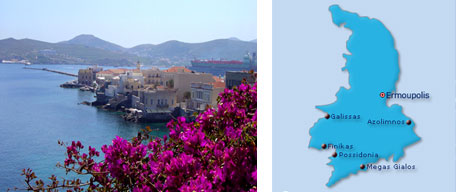
This is the island where Greek tradition and western influence come to a harmonious marriage. Ermoúpoli (meaning “the city of Hermes”) is the island’s capital town and has been the first important trade and industrial centre of the country in the 19th century. Evidence of this glorious past can be seen on public buildings (the City Hall, the Customs Office, “Apollo” theatre), on the neoclassical houses and at the beautiful squares. Due to its economic activity, Ermoúpoli has been called “Manchester of Greece”. The great number of beautiful beaches will delight the sea and sand lovers: Vári, Foínikas, Yalissás and Kíni, as well as Possidonia or Dellagrazia, the beach of a village with many neoclassical mansions with colourful orchards. Internationally acclaimed festivals are held on Sýros, offering a wide range of choices and covering any taste, e.g. The International Cyclades Music Festival, the Classical Music Festival, the Ermoupólia and the Musical May.
Duration:
From Athens (Rafina port) to Syros: about 4 hours by regular ferry.
Poros
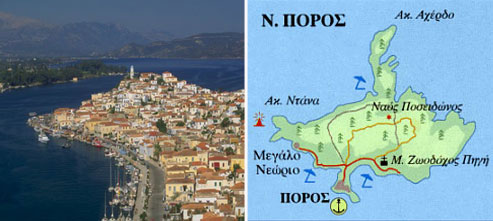
Poros is built in the shape of an amphitheatre over two hills. In antiquity Poros consisted in fact of two islands, Sphería and Kalavria, but the last explosion of the Methana volcano in 273 BC radically changed the morphology of the area. Sphería was cut off from Methana, and in this way Poros took its present-day form. Lush pine trees vegetation, crystal clear beaches, a lively waterfront adorned with shops, cosy cafes and restaurants, a picturesque capital (it has been declared protected settlement) with grand traditional mansions and picturesque cobbled streets, as well as a wide selection of entertainment venues are the ingredients of this quiet, yet cosmopolitan, destination that attracts visitors from all age groups.
Duration:
From Piraeus port to Poros: about 2.5 hours by ferry.
By car to Galatás and then by ferry boat, which operates regularly; the route lasts only 15 minutes.
By boats from Methana, Hydra, Spetses, Aegina and Agkistri.
Hydra
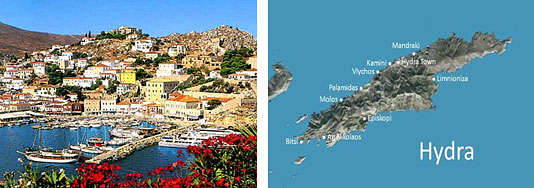
Hydra, built in the shape of an amphitheatre on a slope overlooking the Argosaronic gulf, is one of the most romantic destinations in Greece. Traditional stone mansions, narrow cobblestoned streets, secluded squares and above all the banning of cars and the use of around 500 donkeys as means of public transportation, explain the reason why Hydra preserved its distinctive atmosphere through the passage of time. The island experienced exceptional economic growth in the past thanks to its great naval and commercial activity. It is rather impressive the fact that such a tiny island is the birthplace of five Greek Prime Ministers!
Hydra is also a yachting paradise, as every summer groups of sailing boats moor at the harbour, where they are joined by dozens of sensational motorboats and yachts. It’s worth mentioning that Hydra became famous all over the world thanks to the film “Boy on a Dolphin”, shot on the island in 1957 with Sophia Loren leading the starring role.
Explore the island’s beaches:
- Mandraki: During the War of Independence it was used as a harbour but today it is an organised beach with excellent water sport facilities.
- Bisti: A pebbly beach, where Hydra Diving Centre organises water sport activities such as diving and kayaking
- Vlychos: A beach covered with pebbles at Vlychos holiday resort.
Duration:
There are flying dolphins departing daily from the port of Piraeus and take about 1.5 hour to Hydra
OR: By helicopter!
There is a flat area close to town of Hydra, which is used as a place for helicopters to land and take off. Air Heli, based in Porto Heli, also has air transport links to Hydra.
Aegina
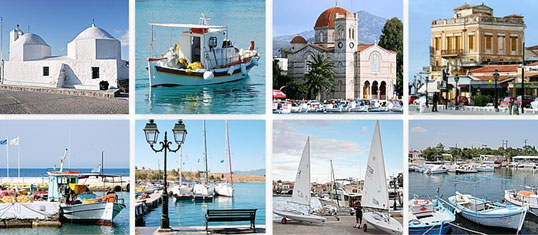
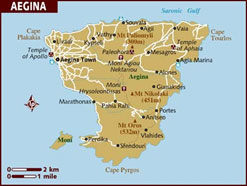
The island of Aegina is one of the most popular tourist destinations as it is the closest island to Athens (only 16.5 nautical miles from the port of Piraeus).
The island boasts a great number of sights and natural beauties, highlight of which is the famous Aphea Temple. It forms in fact an equilateral triangle with the Parthenon and the Temple of Poseidon at Sounion, the so-called “holy triangle” of the antiquity.
Aegina town, the capital of the island, stands out for its well-preserved buildings. On the outskirts you can find charming little villages with distinctive traditional character, such as Kypseli, Agii and Vagia as well as organized tourist resorts like Agia Marina, Perdika, and Souvala. Aègina is also surrounded by many smaller islands (Moni, Metopi, Diaportia, Lagouses, Kyra, Dorousa, Spalathonisi, Anonyma) that can be reached by boat from the port of Aegina.
Duration:
From Piraeus port to Aegina island there are many ferries daily and take about 1 hour.
Classical Greece
Prehistory, the Classical period, Roman domination, the Byzantine Empire, the Crusades and Modern times: Greece through the centuries.
You can visit the most important historical sites in 4 days minimum. Below is a description of the most important historical sites visited in 4 days. Of course you can choose if you want to visit less places and do a tour less days.
1st day: Leave by the coastal road to the Corinth Canal (short stop). Drive on and visit the Theatre of Epidauros, famous for its remarkable acoustics. Then proceed to the town of Nauplion (short photo stop), drive on to Mycenae and visit the Archaeological Site and the Tomb of Agamemnon. Then depart for Olympia through Central Peloponnese and the towns of Tripolis and Megalopolis. Overnight in Olympia, the cradle of the Olympic Games. (Dinner)
2nd day: In the morning visit the Archaeological Site with the Sanctuary of Olympian Zeus, the Ancient Stadium and the Archaeological Museum. Then drive on through the plains of Eliad and Achaia until the magnificent bridge which is crossing the Corinthian Bay from Rion to Antirion. Pass by the picturesque towns of Nafpactos (Lepanto) and Itea, arrive in Delphi. Overnight. (Dinner)
3rd day: In the morning visit the Archaeological Site and the Museum. Depart for Kalambaka, a small town stated at the foot of the astonishing complex of Meteora, gigantic rocks. Overnight. (Dinner)
4th day: Visit Meteora, among striking scenery, perched on top of huge rocks which seem to be suspended in mid-air, stand ageless Monasteries, where you can see exquisite specimens of Byzantine art. Return to Athens via Trikala, Lamia, Thermopylae (short stop to see across the road the Leonida's Monument). Arrive in Athens early in the evening.
N.B. Please ladies for the visit of the Monastery you need a skirt and the gentlemen long trousers.
Religious Greece
...innumerable churches and monasteries give testimony to the country...
The wealth of its Byzantine monuments makes Greece the perfect destination for thousands of religious pilgrims. Monuments of centuries-old ecclesiastic architecture and art, innumerable churches and monasteries give testimony to the country's rich religious heritage.
Byzantine and post-Byzantine churches in cities or in small villages, cathedrals, small churches in the countryside, monasteries and cells, decorated with excellent mosaics, paintings and icons, testify the persistence of faith and tradition.
In western Thessaly, Meteora, the 14th century Byzantine monasteries, are sinuously perched on the summits of smooth and vertical grey rock pinnacles.
Built on the easternmost finger on the Halkidiki peninsula of northern Greece, the over 1000-year-old monastic community of Mt. Athos includes twenty monasteries containing some of the finest examples of Byzantine treasures and a plethora of classical and medieval manuscripts. Finally, on the island of Patmos, the monastery of St. John the Theologian and the Cave of the Apocalypse, where St. John is believed to have written the Book of Revelation in the later part of the 1st century AD, count among the most wondrous monuments world-wide.
Travellers following the steps of St Paul through the biblical sites of Corinth, Lechaion, Cenchrea, Athens, Thessaloniki, Philippi, Christoupolis (today's Kavalla) - the first European city to convert to Christianity - and the island of Rhodes, are on a journey to an unforgettable religious experience.
Northern Greece - Alexander the Great
To explore Macedonia, the Land of Alexander the great, make a unique journey through 7.000 years of Greek History and meet parts of a Countryside you will always remember we suggest a tour of minimum 5 days as per the following.
1st day: Drive through the fertile plain of Beotia region, passes by the towns of Thebes, Levadia and via the picturesque village of Arachova, arrives in Delphi and visit the Archaeological Site. Depart for Kalambaka, a small town situated at the foot of astonishing complex of Meteora, gigantic rocks. Overnight. (Dinner)
2nd day: Visit Meteora, among striking scenery, perched on the top of huge rocks which seem to be suspended in mid-air, stand ageless Monasteries, where you can see exquisite specimens of Byzantine art. Depart from Kalambaka, drive through the plain of Thessaly and the valley of Tempi, arrive and visit the Archaeological Park of Dion. Admire also the gigantic figure of Mount Olympos, the highest mountain in Greece and home of the 12 Gods of Mythology. After the visit depart for Thessaloniki, the second largest and the most vibrant city in Greece. Dinner and overnight.
3rd day: Depart in the morning for a unique approach to historical Macedonia. First stop at Veria (Biblical Beroea) to visit Saint Paul's Bema, and then stroll through the old Jewish neighborhood and the colorful market area. A walk in a city where past is present and around. Then proceed to Naoussa, to a site of exceptional beauty and importance: Aristotle's School, the impressive scenery where the great philosopher taught ‘the doctrines of morals and politics' to Alexander and the Macedonian youths. In only a few miles away is picturesque Edessa where we see the town's famous landmark, the Waterfalls. Then, comes Pella, the capital of Alexander the Great. See the exquisite floor mosaics of the 4th century b.C. villas, in situ as well as in the new Museum. Return to Thessaloniki for dinner and overnight.
4th day: See in the morning the city that throughout the era of the Byzantine Empire, was the "co-reigning" city, second in population and prestige only to Constantinople. Visit unique monuments and feel the glorious Byzantine past in some of the oldest and most characteristic churches of the Christian world as well as in the Museum of Byzantine Culture, awarded with the Council of Europe's Museum Prize for the year 2005. Rest of the day free, to enjoy time in the lively center of the city. Dinner and overnight.
5th day: Drive to Vergina, to live the experience of a visit to the unique Museum, created in the Great Tumulus covering the royal tombs of Macedonia. See the astonishing findings from the tomb of King Philip II, Alexander's father, and feel the thrill of the greatest discovery of the 20th century. After the visit we shall start driving south and through Thessaly, Lamia, Thermopylae (see the Leonidas' Monument) and Thebes, arrive in Athens late in the afternoon.
Congresses in Greece
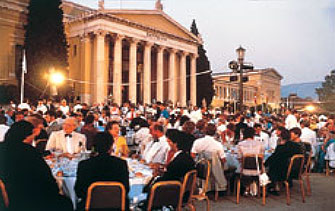
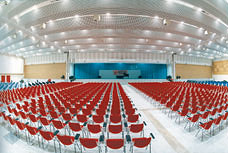
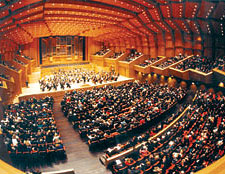
The ideal destination for world-class congress tourism
Its rich cultural heritage, unique natural environment and mild climate, as well as its multifaceted tourism resources render Greece the ideal destination for world-class congress tourism and incentive travels.
We should not forget that the concept of the congresse
was born in Ancient Greece with the Delphic Ampyctionies.
Greece aims very high by steadily improving its infrastructure with a multitude of new projects in the light of the Olympic Games 2004, such as the Eleftherios Venizelos International Airport, one of the largest and most contemporary world-wide, the establishment of large congress and exhibition centres, as well as numerous luxurious hotel units featuring congress facilities staffed with experienced professionals.
Among the top priorities of the congress sector's professionals and the relevant public authorities - such as the Ministry of Tourism, the Ministry of Development, the Greek National Tourism Organization (GNTO), and the Hellenic Association of Professional Congress Organizers (HAPCO) - is the promotion of the country's competitiveness, the qualitative improvement of services, and the establishment of information offices for Congress Tourism in all major Greek cities, such as the Thessaloniki Conventions
and Visitors Bureau (TCVB), the Athens Conventions and Visitors Bureau (ACVB), the Conventions and Visitors Information Centre of Edessa City, and relevant offices that will operate soon in Rhodes, Crete and Patra.
The Olympic Games 2004 that were held in Greece, the large infrastructure projects nearing completion and the co-ordinated efforts made by all agencies, will assist our country in gaining a much larger segment of the international competitive congress-market and to be recognised as an ideal choice and destination for congresses, incentive travel and a number of other organised and specialised events that make-up the congress-tourism industry.
Golfing
...golf tours combined with visits to the classical sites of Greece...
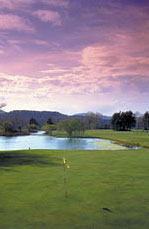
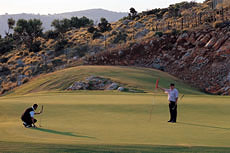
Golf is a game in which a ball is struck with a club from a prepared area, known as the "teeing ground" - the starting place for the hole, defined by two tee-markers - across fairway and roughly to a second prepared area, which has a hole in it, known as the "putting green".
The object of the game is to complete what is known as a hole by playing a ball from the teeing ground into the hole on the putting green in the fewest possible number of strokes. A "round of golf" consists of playing 9 or 18 such successive holes.
There are basically two forms of play, one which is decided by holes won and lost (match play) and the other which is decided by the total number of strokes taken to complete the round (stroke play).
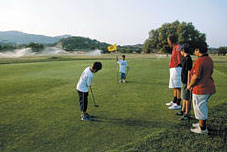 "Match play" is a competition format in which the round is played with the purpose of winning individual holes. Scoring is kept by comparing the holes won by each player.
"Stroke play" refers to a round of golf in which the score is kept by adding the cumulative total of strokes taken throughout the round. The competitor who plays the stipulated round or rounds in the fewest strokes is the winner.
Greece has not yet developed a comprehensive golf culture, but there are still some courses to allow the visitor to explore a different kind of "Classic" in Greece.
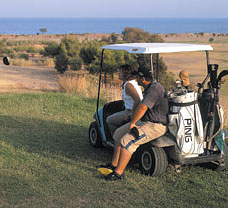 However, Greece is a country with a mild Mediterranean climate and an average temperature in winter months that render it an ideal golf location in autumn, winter and spring.
Golf enthusiasts or merely vacationers that wish to try out this sport can choose from one of the country's five greatest locations: the Glyfada Golf Course, a well established, pine-studded course near Athens; the Porto Carras Golf and Country Club in Northern Greece, at Chalkidiki, the famous three-finger peninsula; the Afandou Golf on sun-kissed Rhodes, where an International Championship Cup is organized twice a year; the Corfu Golf Club on enchanting Corfu; and last but not least, the Crete Golf Club at Chersonissos, an ultramodern 18-hole course open year-round. Besides, very close to the Crete Golf Club lie the MARIS HOTELS [www.maris.gr] (Creta Maris, Silva Maris, Bella Maris, Candia Maris, Terra Maris, Villas Arhanes and Avdou Villas), and golfers may choose the one that suits them best.
A number of tour agencies offer several golf tours combined with visits to the classical sites of Greece and the Greek islands.
The Hellenic Golf Federation lists about 1200 members throughout Greece. There is a P.G.A. office in Greece, located at the Glyfada course.
Ski
A world of difference
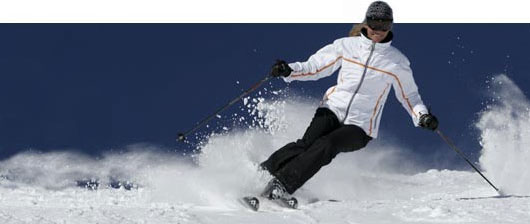
We offer you now a new face to your winter holidays in Greece and this is SKI.
In addition you will explore and enjoy this unique country the cradle of all sports, with the first Olympian Games, held in 776 B.C.
Winter sports are developing very fast in Greece and offer excellent service to skiers, all the ski runs have been carefully laid with packed earth and grass for the comfort and safety of skiers.
There are training schools for the beginners and shops where skiing gear, for children – teenagers – beginners and experienced skiers, can be hired.
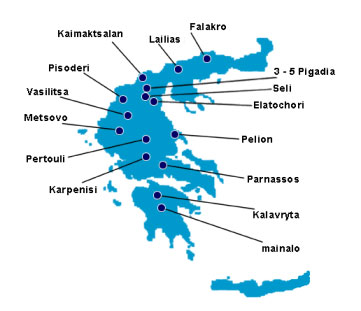
Ski centers
Greek mountains generally offer skiing opportunities from December to march (altitute 1,800m ) and some of the higher ones, Mount Olympus and Pindus range until May.
The following ski centers are served by chair-lifts:
Mount Vermio
18 Km from Naoussa, 28 km from Veria.
Total ski run from the Hellenic Alpine Club refuge to the Assourbassi Plateau is 1,200 m.
Metsovo
The starting point is just outside the town.
Mount Pelion
28 km from Volos
Total distance covered by the two chair-lifts is 2,100m
Mount Parnassos
27 km from Arahova, 17km from Amfiklia.
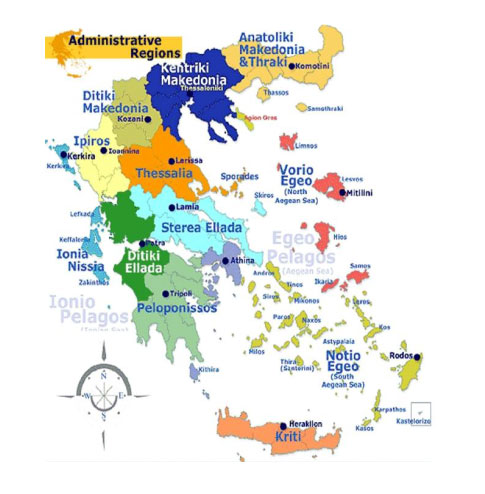
Here is a map of Greece with all the ski centers.
Adventure tourism- a window to nature
Trekking
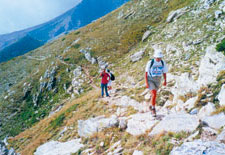
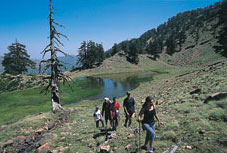
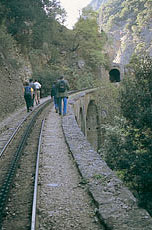
Trekking in routes and paths together with professional mountain guides.
Where can I do trekking?
- Eyrytania -Agrafa, Mt.Helidona, Mt.Kalliakouda, Krentis
- Kastoria - Kataraktes
- Tzoumerka - Kalarites
- Peloponnese - Lousios Gorge, Mt Taygetos, Mt. Helmos
- Crete - Samaria Gorge, Αg. Irini Gorge, Trekking in the south coast, White Mountains, Psiloritis Mt., Lasithiotika Mts.
- Cyclades
- Ithaka
- Zagorochoria - Vikos Gorge, Voidomatis, Vradeto, Mt.Gamila, Dragon lakes
- Mt. Olympus
- Grevena - Valia Calda National Reserve, Orliakas, Flegga Lakes
- Corfu - Korissiona Lake
- Kalavrita - Vouraikos Gorge
- Mountainous Pella - Kaimaktsalan, Tzena, Pelovo
- Drama - Mt. Falakro, Paranesti region, the forest of Frakto, the forest of Elatia, Path E 6, Mt Menoikio
- Xanthi - Leivaditi Waterfalls, Stena Nestou, Koula, Gyftokastro
And in other places in Greece....
When can I do trekking?
Throughout the year, depending the location.
Participation Requirements
No previous experience is required in order to participate in an easy, one or many day, trekking trip. For more demanding trips you must be in good physical condition. Ages 10-65 years old.
What do I need to carry with me?
What you need to have with you is a pair of trekking shoes, comfortable clothes, waterproof jacket, a hat, sun glasses, a back pack and a flask, light food (raisins, chocolate, sandwich). For many day treks you will need a sleeping bag and a torch.
Necessary Equipment
In more than one-day treks, you need tents; carry mats, and camping equipment. In mountaineering expeditions specialised equipment such as crampons, axes, ropes, sleeping bags and tents are provided.
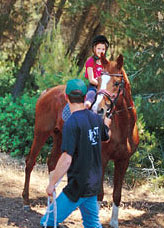
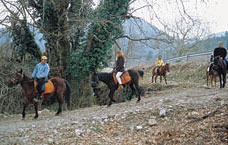
Horseback Riding
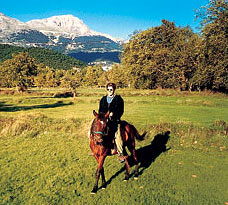
Horse riding excursions in mountain trails with professional horse riding guides.
Where can I do horse riding?
- Evrytania -Korishades
- Nafpaktos - Evinos Riverbanks
- Epirus - Lazaina
- Pelion - Katigiorgis, Argaliasti
- Corfu - Kato Korakiana/Ropa Valley, Mount Pantokrator
- Crete
- Mountainous Pella - Loutraki, Ag. Athanasios, Kaisariana
- Xanthi - Stavroupoli, Avdira, Vistonida
- Drama - Volakas
- Katerini - Ano Skotina Pierias
And in other places in Greece...
When can I do horse riding?
Throughout the year.
Participation Requirements
In order to participate in this activity, you don't need to have previous experience.
What do I need to carry with me?
You just need to wear long trousers and athletic or trekking shoes.
Necessary Equipment
Helmets.
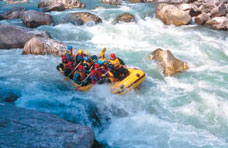
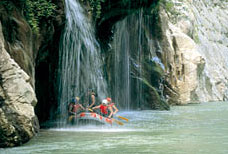
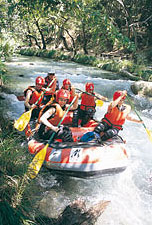
Rafting
River descent with inflatable boats.
The crew consists of 6-8 paddlers and one professional river guide.
Where can I do rafting?
- Peloponnese - Lousios & Alfios River (grade II-III), Ladonas River
- Evrytania - Acheloos River (grade I), Tavropos River (grade II), Trikeriotis River (grade III)
- Meteora - Aspropotamos (grade III), Aliakmonas (various difficulty levels from 1-5)
- Grevena - Venetikos river (various difficulty levels from 1-5), Mileopotamos River (grade IV)
- Kissavos - Pinios (various difficulty levels from 1-3)
- Zagorochoria - Voidomatis (grade I-II)
- Serres - Alistrati, Aggitis (grade II)
- Drama - River Aggitis (grade of difficulty 3), River Nestos (grade of difficulty 2)
- Kastoria - Nestorio (grade II)
- Tzoumerka - Kalaritikos, (grade IV) Arachthos (various difficulty levels from 1-4)
- Nafpaktia - Evinos (grade II)
- Mountainous Pella - Moglenitsas, Edessaios
- Xanthi - Nestos (difficulty level 1-3)
And in other places in Greece...
When can I do rafting?
Rafting usually takes place in Greece between October to May, though in some rivers you can enjoy rafting throughout the year.
Participation Requirements
In order to participate in a descent you have to start from rafting in rivers of 1st and 2nd grade of difficulty. You can then gradually continue to more difficult descents of 3rd-4th degree of difficulty. You must know how to swim and be in good physical condition.
What do I need to carry with me?
What you need to have with you is a pair of shoes that will get wet, a swimming suit, a t-shirt and a towel.
Necessary Equipment
A neoprene suit and pair of socks, windproof jacket, helmet, life jacket and a paddle.
Thalassotherapy in Greece
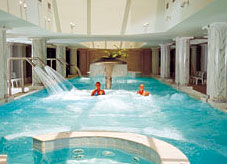
Hippocrates, the Father of Medicine, was the first to discover the therapeutic virtues of seawater by observing the beneficial effects it had on the injured hands of the fishermen. Prompted by the fact that the contact with the seawater restricted infection risks, his medical genius made him encourage his patients to follow treatments involving the use of seawater even for pain relief. It is by now known that thalassotherapy is an effective treatment system that assists in the rejuvenation of the cells using fresh heated seawater, which induces an exchange of minerals and toxins between the blood and the water.
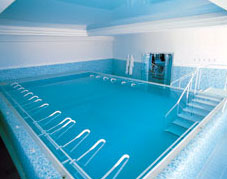
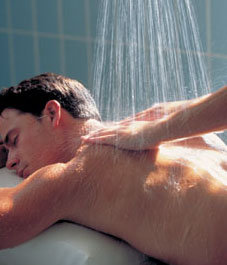
Already, a great number of luxurious hotel units throughout Greece feature most contemporary thalassotherapy and spa centres, (Sanus Per Aqua, health through water) with excellent equipment and well-trained personnel. They include daily bathing in a heated seawater pool with jets and other facilities such as hydro-massages, aromatherapy or algae wraps. Thalassotherapy is the associated and simultaneous use of the beneficial effects of the seawater and its components, while the sea algae impart many beneficial effects out of the therapeutic virtues of seawater.
The number of thalassotherapy and spa centers increases every day, especially in the luxury hotels and resorts in Greece. There is also a great number of luxury hotels spa and welness spa hotels, that offer a variety of beauty, welness and sport programs, with or without thalassotherapy.
The treatment programs at most hotels include a combination of seawater, algae and mud, to maximise the benefit that the human body can get from the marine environment. Thalassotherapy has many more beneficial effects, including relaxation, stress management, muscle and skin restoration, even weight control. Most importantly, it aims to improve health and it identifies with the simultaneous implementation of a balanced and healthy diet program.
Characterised by its dependable sunshine full of bracing, restorative powers, Greece's coastal climate contributes to the creation of an ideal environment for the application of thalassotherapy treatment programs, so as the greek thalassotherapy centers and spa in the greek luxury hotels to be as good as those abroad. In this way Greece will become a unique destination for those who are interested in SPA HOTELS, WELNESS SPA HOTELS, therapeutic tourism and health tourism in general.
Most famous SPA Hotels in Greece:
Athens:
Crete:
Chalkidiki:
Mykonos:
Santorini:
Gastronomy
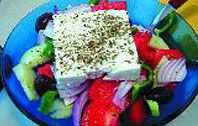
Greece, with a culinary tradition spanning 4,000 years, is the country which invented the symposium and which was home to the Epicurean philosophers.
It was here, where the first book on cooking was written in 330 BC by Archestratus, a reminder that a country’s cuisine is a measure of its civilization. Ancient Greeks were pioneers in the art of cookery; authentic Greek cuisine, unique and full of vitality, just like the people of the land, marries the taste and the aroma of the fresh products coming from the Greek land and the blue sea that surrounds it.
Greek cuisine is characterized by frugality, based on simple ingredients, crispy fresh vegetables, virgin olive oil, honey, succulent fruit, fresh fish and, naturally, exquisite wines made with grapes ripening under the magnificent Greek sun, for decades now gaining ground on the world’s vinicultural stage.
International studies have recognized the value of the Greek cuisine. Launched in the early 60’s by the World Health Organization, the Seven Countries Study set out to examine the eating patterns of people from seven different countries: Greece, Italy, Serbia, Holland, Finland, the USA and Japan. This long-running study which lasted for 30 years showed that people living in the Mediterranean countries, Greece in particular, had lower mortality rates compared to the rest of the participating countries.
The Mediterranean diet is not simply a Greek claim. it is a unanimous conclusion reached by the international scientific community which supports that the traditional dietary patterns of the people residing around the Mediterranean basin are healthier compared to western eating habits.
Greek traditional cuisine and Greek gastronomy, the wine-making tradition, the great variety of dishes that changes with season and geography, the culinary habits passed down from generation to generation constitute elements ofthe overall Greek culture and each region individually (Cretan diet, island cuisine, Macedonian cuisine etc).
Greece has the potential and has become a gastronomic destination.
Calendar of Events
January
January 1, Sant Vasil (Aggios Vasilios). Is the Greek equivalent of Santa Claus. A special cake, vasilopita, is made with a coin in it; the person who gets the piece with the coin will have good luck.
January 6, Epiphany is celebrated with the blessing of baptismal fonts and water.
January 8, Gynecocracy (Gynaikokratia) is celebrated in some villages in
Thrace, when women take over the cafes and the men stay home and do the
housework.
February-March
Carnival (To Karnavali) in various regions of Greece Carnivals are held which have as their main characteristic the distinctive local color and the people's intention to keep the tradition alive.
The Carnival celebration usually begins on Tsiknopempti with a series of cultural, theatrical and other events. The participants are masquerade parties, float parades, majorettes, ballet groups and music bands etc. which fill the streets, theatres, cultural centres and squares of the whole country. The celebrations reach their climax with the traditional party (Koulouma) on Ash Monday, when a kite-flying spectacle takes place.
The city of Patras shows its support of the latter theory with its famous chariot parade and wild Saturnalia, private panics and public celebrations, Masked revels are also widely held in Macedonia.
On the island of Skyros, the pagan "Goat Dance" is performed, reminding us of the primitive Dionysiac nature of the festivities. Crete has its own colorful versions, while in the Ionian islands, festivities are more Italian. In Athens, people bop each other on the head with plastic hammers. Celebrations last the 3 weeks before the beginning of Lent.
In Galaxidi the carnival events usually begin three Saturdays before Ash Monday by lighting bonfires accompanied by music, appetizers and plenty of wine. Then comes the carnival with floats, disguised costumes and carnival bands with violins and drums followed by the "alevromoutzouroma".
At "alevromoutzouroma" participants gather at the port where starts the war with flour! Old clothes or a special suit of nylon are required!
It's a very fun tradition and all you have to do is to arm yourself with good humor and fun and take part in the ¨ war ¨ alefromoutzouromatos" !
March
March 25, Independence Day and the Feast of the Annunciation. The religious celebration is particularly important on the islands of Tinos and Hydra arid in churches or monasteries named Evanggelismos ("Bringer of Good News") or Evanggelistria (the feminine form of the name).
April
Sound & light performances begin at the Old Town on Rhodes. The history of the city with music, drama and lighting effects. Nightly to October.
May
May 1. May Day is an important urban holiday when families have picnics in the country and pick wildflowers, which are woven into wreaths and hung from bal- conies and over doorways.
Folk-dance performances begin in the amphitheater on Filopappos Hill in Athens and continue to September.
Sound & light shows begin in Corfu town and continue to mid-September.
June
Athens Festival features superb productions of ancient drama, opera, orchestra performances, ballet, modern dance, and popular entertainers in the handsome Odeum of Herodes Atticus June through September.
Wine Festival is held annually at Daphni, about 10 kilometers (7 miles) west of Athens; other wine festivals are held on Rhodes and elsewhere.
Aegean Festival on Skiathos presents ancient drama, modern dance, folk music and dance, concerts, and art exhibits in the Bourtzi Cultural Center in the harbor of Skiathos town. June through September.
European Music Day
European Music Day is the biggest annual music event in Greece. It takes place over three days around 21 June. Music stages are set up all around the city as well as in Technopolis, in Gazi, for free concerts. Many Greek artists travel abroad to play in similar concerts, while Greek and foreign artists/bands from a variety of music genres give performances in Greece.
Rockwave Festival
Rockwave is the biggest pop rock event of the summer in Athens. Every summer this festival takes place near Athens at the Terra Vibe Park in Malakasa with a line up of well known international bands and musicians.
July
Hippokrateia Festival in Kos island – July & August. Celebrates the birth of Hippocrates with athletic events and concerts.
Rennaissance Festival in Rethymnon, Crete –July – September. Celebrates, with much fanfare, the island’s history.
Dodoni Festival presents classical dramas at the ancient theater of Dodoni, South of loannina. July through September.
Epidaurus Festival of classical Greek drama begins in the famous amphitheater and continues to early September.
Ancient Olympia Festival July-August, 2 km, at village Floka characterized by the variety of themes and aims to the appointment of all the areas of the ancient site, the two ancient theaters (THE THEATRE OF OLYMPIA FLOKA and the small theatre Drouva), the exhibition areas, events at the pedestrian zone of Olympia town. Concerts, theatrical plays for children and adults, photography exhibitions and even more are waiting for the visitors to enjoy a wonderful summer.
Ancient Ilida Festival July-August 57 km, near Kyllini. Mideia, Orestis, Ekavi, Iphigenia and other ancient comedies and dramas come back to life every summer in the Ancient Theatre of Ilida. Ancient Ilida, was one of the most important cultural centres of Peloponnesus in ancient times, and was the host city of the Games and the capital of Ilia. This leading cultural event includes representations in the Ancient Theatre of Ilidas, musical events in the Castle Chlemoutsi as well as parallel activities in the place of ancient Ilida and in the city of Amaliada.
August
Aeschylia festival of ancient drama stages classical dramas at the archaeological site of Eleusis, home of the ancient Mysteries and birthplace of Aeschylus, west of Athens. August to mid-September.
International Folklore Festival - Lefkada island For 45 years groups and artists from various countries around the world meet every august in Lefkada and share the creations of their intellectual and artistic traditions (dance, music, traditional heritage).
August 15, Feast of the Assumption of the Virgin is an important day of religious pilgrimage. The holiday reaches monumental proportions in Tinos; thousands of people descend on the small port town to participate in an all-night vigil at the cathedral of Panagia Evanggelistria, in the procession of the towns miraculous icon, and in the requiem for the soldiers who died aboard the Greek battleship Elli on this day in 1940.
Epirotika Festival in loannina presents theatrical performances, concerts, and exhibitions.
Olympus Festival presents cultural events in the Prankish Castle of Platamonas, near Mount Olympus.
Routes in Marpissa, Paros island On the 20th, 21st and 22nd of August, at Marpissa, Paros Island, local residents and visitors take part in an original experiential festival. Through the Routes in Marpissa visitors get the opportunity to get to know the authentic character of the place and local residents get the chance to discover hidden sides of their rich inheritance.
Ardas festival in Evros For eight continuous summers, in Ardas river banks, close to Kastanies village in Evros takes place a powerful music camping festival which evolves every year and attracts even more young people in this frontier but beautiful area. Travel to Evros to live the experience of the festival "Ardas-Youth Meeting".
September
Thessaloniki International Trade Fair. This is one of the world's major trade
fairs. Rooms are scarce in the city, so if the fair's not your destination, try to come to Thessaloniki at another time.
Thessaloniki Film Festival and Festival of Popular Song. That lively and sophisticated city continues to live it up. End of September.
Aeschylia Festival
This cultural event is organised by the Municipality of Elefsina, Attica near Athens. The Festival is a tribute to the Greek poet and drama writer Aeschylus. It takes place annually early autumn and includes concerts, exhibitions, theatre and dance performances.
Book Festival
A book festival of (mostly) Greek-language books takes place every September in Athens. The venue for the event may vary from year to year. Every publisher has a little stand from which they sell a selection of their published books. The festival is organised by the Book Publishers Association in collaboration with the Cultural Organisation of the City of Athens and the Athens Book Publishers Association.
October
October 26, Feast of St. Demetrius (Agios Dimitrios) is particularly important in Thessaloniki, where he is the patron saint.
October 28, Ochi Day {ochi in Greek = "no"). Day when General Metaxas negative reply to Mussolini's demands in 1940.
November
November 8, Feast of the Archangels Gabriel and Michael (Gavriel and Mihail), with ceremonies in the many churches named for them.
November 30, Feast of St. Andrew (Agios Andreas), patron saint of Patras, is another excuse for a party in that swinging city.
December
December 6, Feast of St. Nikolaos (Agios Nikolaos) the patron saint of sailors. Numerous processions head down to the sea and the many chapels
dedicated to him.
December 25 and 26, Christmas. The day after Christmas honors the Gathering Around the Holy Family (Synaksis tis Panagias).
December 31, New Year's Eve, when children go out singing Christmas carols (kalanda) while their elders play cards, talk, smoke, eat, and imbibe.
Cultural Events in Greece
Greece has a large diversity of cultural events, among they are:
- Hellenic Festival occurs in Athens’s Herodes Atticus theatre and proposes a large range of performances: modern and ancient theatre, ballet, opera, jazz and classical music, dances, symphonic music and great singers and several other singular events. The festival occurs from June 2 to September 28.
- International Jazz & Blues Festival occurs in Athens, in June, is welcomed by the theatre of Lycabettus. Lycabettus also welcomes every year many other events such as music, dances and theatrical performances from the national and international scene.
- Epidaurus Festival. The ancient theatre of Epidaurus meets a festival of Classical drama performances every summer during the months of July and August. It is one of Greece’s top events which attract thousands of visitors every year.
- The Film festival of Thessaloniki. This Festival is the Balkans primary showcase for the work of new and emerging filmmakers and leading film artists in the region and beyond. The event offers the International Section, the panorama of Greek films, the New Horizons program, the Balkan Survey, and numerous tributes to leading figures in the world of film.
- International Festival of Patra occurs from July to September and presents drama, theatre and classical music performances.
- Rockwave Festival meets every summer in Athens to the international bands and musicians.
- European Music day which also meets every summer in Athens, during 3 days, international and national bands and musicians for all night long.
- Samothraki Festival individually from a musical event is an important meeting for ecology. It will take place in Samothraki Island in July the 21,22,23 and 24.
- Sani Festival. An annual celebration since 1993, this festival unites nationally and internationally admired artists at the Sani Resort. Events such as music concerts, dance performances and painting exhibitions are held in different venues around the Sani Resort from July to September every year.
| ARGOLIDA |
Athens & Epidaurus festival
Athens and Epidaurus Festival promises you magical summer nights, full of music, theatre and dance! Experience theatre as the ancient Greeks did in one of the greatest masterpieces of Greek... |
Festivals in ancient theatres
Here are the most famous summer festivals in ancient theatres all over Greece. Join the Festivals' loyal fans to a journey into the magic world of art and immerse into sacred centuries-old art... |
|
| ATTICA |
Athens & Epidaurus festival
Athens and Epidaurus Festival promises you magical summer nights, full of music, theatre and dance! Experience theatre as the ancient Greeks did in one of the greatest masterpieces of Greek... |
Festivals in ancient theatres
Here are the most famous summer festivals in ancient theatres all over Greece. Join the Festivals' loyal fans to a journey into the magic world of art and immerse into sacred centuries-old art... |
|
| CYCLADES |
Routes in Marpissa
On the 20th, 21st and 22nd of August, at Marpissa, Paros Island, local residents and visitors take part in an original experiential festival. The traditional core of the village has been charted... |
|
| DRAMA |
Drama International Short Films Festival
The Short Films Festival first opened its doors in 1978, but for Greek films only. Experienced enough, it turned international in 1995. Making a dash from toddling to steady walking, it earned fame... |
|
| EVROS |
Panhellenic festival of Greek traditional Dances
Setting the boundaries on messages and meanings we receive from dances and songs of our folk culture we chose to present the dance and music action of some traditional communities in Greece, focusing... |
|
| ILIA |
The Andravida horse show
The Andravida horse show September 60 km, near Kyllini The Andravida horse is almost impossible to find outside of the Ilia region of Greece. The lines of this horse can be traced all the way... |
|
| MESSINIA |
Kalamata International Dance Festival
Enjoy the 16th International Dance Festival in one of the most gifted cities in Greece, Kalamata The Kalamata International Dance Festival is the crown event of the year for the city's... |
|
| THESSALONIKI |
Thessaloniki International Film Festival
In November, Thessaloniki – the arts city – becomes the centre of international filmmaking. Great Greek and foreign artists arrive in large numbers to compete on their art, adding to the everlasting... |
|
| XANTHI |
Xanthi’s Old Town Festival
Since 1991, Xanthi’s Old Town Festival takes place at the beginning of autumn. This year, for the twentieth time, it will offer us once again unforgettable moments of recreation and fun! The... |
|
| LOCATION UNRELEATED RESULTS |
European Music Day
European Music Day is the country’s biggest open air, entrance-free musical gathering! A true celebration dedicated to Music, Musicians, our cities and their people. A celebration that brings people... |
International Festivals in Greece
Well-reputed interational festivals are held in Greece every year, inviting you to take part as entrants, or initiating you as spectators into a world of music, theatre, cinema and dance. We have... |
International short film festival in Drama
The “Spring” of Greek cinema this autumn in Drama! From the 20th until the 25th of September, Drama, a city with a rich historical background, welcomes again this year the film fans, inviting them... |
|
|